"INFORMATION INSTINCTS"- Designing E-reading Experiences

Information Instincts is a proposal and prototype aimed to create productive e-reading experiences that enable the user to build their own schema of filtering, browsing and reading the content from fast updating on-line sources (news, blogs, tweets, etc.) The behavior of such a system is an algorithmetic outcome of what one has read throughout the time, their collecting habbit and the occurance of a different scenarios.

We intended to fit our design into the context of increasingly complex and diverse presence of information, and in particular, the design of the e-reader aims to enable creating one's own meaning space where information is not presented in a straight "flat" format. Instead, the user will be offered affordances that enable them to organize, manipulate and view the information the information in a way that lets them to build a custom experience and shape the information to their own needs.

Collaborative project with Daniel Lara Saucedo and Hoon Oh


The Inspiration

The idea being "Info instinct", refers to an active feeds of information that will find way to the reader themselves, based on all the reading history of the reader. This is a situation when the user doesn't feel like actively searching for new information themselves but stick more to their familar topics and magazines. Meanwhile, there can be another situation that the user need to do some active searching and looks for more specific content. In our idea, a reader can adjust swiftly between the two situation and can have a combination of the two reading scenarios, namingly the "passive" and the "active" reading situation.


The Attitude

Our attitude towards this project is experimental. We are aiming to create a new way of accessing and organizing information so we can easily see patterns and connections to other areas of interest.


The Concept

Our attitude towards this project is experimental. We are aiming to create a new way of accessing and organizing information so we can easily see patterns and connections to other areas of interes

We have identified two extremes while approaching reading:
Active: The user actively looks for specific information that is needed.
Passive: The user takes a serendipitous journey, expecting to find something new and interesting.

If we visualize one extreme as black and the other as white, we soon realize that people's reading habits are varied on a greyscale, based on different scenarios: the two reading modes do not exclude each other.

We think it would be very useful to sort the ocean of information according to our reading interests first, but also to have an open end to include serendipity. With our E-reader the user can choose any point between being an active and a passive reader.


Format affordances:

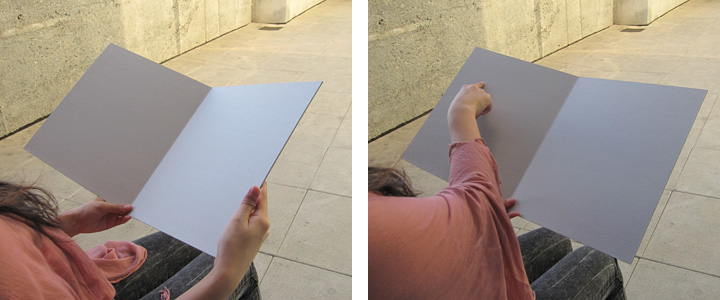
We experimented and compared several traditional medias and their affordances and propose for a center-folded tablet of touch surface made of semi-flexible material.

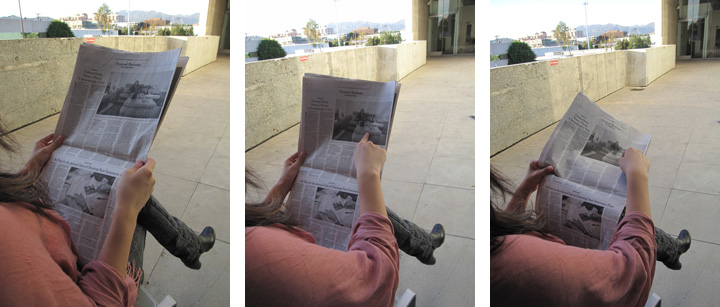
A classic newspaper does not allow a touch interface:


Also, the size of 13 by 23 inches is too big for a touch interface:


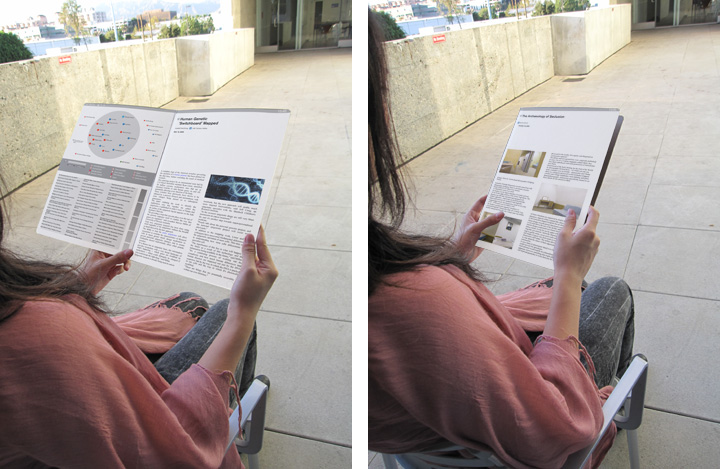
A 18 by 12 inches (9 by 12 folded) is found to be the optimal size for a touch interface. When half folded, it can easily fit into one's bag, while it also forms into a comfortable size for reading a single section, as most people will half fold a newspaper when reading in a public place.


The Prototype

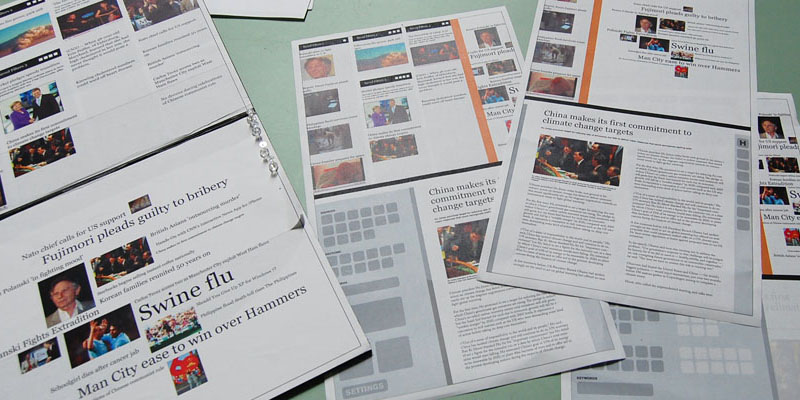
We made a prototype based on Flash Actionscript. The video below goes through the new functions of our e-reader with a live comment.

Introduction:

Navigational function:

Managing the archive: